- Sep 2, 2024
Fabric TYPE vs Fabric COMPOSITION
- Elizaveta Bennett
What's the difference between fabric type and composition? Is 100% chiffon a thing? What about wool blend? If you're not a textile junkie, navigating the world of fabrics could be tricky. Especially, when many businesses are deliberately trying to confuse you and hide information from you behind clever marketing words.
Every single day I’m scrolling online, and I see this nonsense everywhere, from fabric shops to ready-to wear brands. Some are obviously hiding shit behind clever marketing words like “cotton rich” or “silky touch”, but some seem to be oblivious to what the fabric composition actually is.
My favourite way to explain the difference is using food as an example.
Let’s say I want to make a salad, I need to pick ingredients for the salad. I’ll get a lettuce, tomatoes, cucumbers, a pepper, tofu and olive oil.
Now these are the ingredients for my salad. They are not a salad. The ingredients to a salad are like fabric composition to a fabric type.
Sometimes fabric composition is used interchangeably with fabric type, you might say it’s a cotton t-shirt.
But you can’t use fabric type to describe composition.
Like I can’t say that a tomato is a veggie salad.
Veggie salad is like fabric type
There are different types of veggie salads. What defines the difference in taste is the ingredients.
Same goes for fabrics.
Take jersey, for example. Your typical t-shirt fabric. Is jersey composition? No, of course not. Jersey is actually an island that gave the name to the fabric. Jersey is a type of fabric - it’s knit fabric.
But the composition can be anything. Just like the salad, It could be 100% cotton, or 100% linen, or 50% cotton 50% linen, or 100% wool. These are all the great options because these are the natural fibres.
Jersey can be also made with synthetic fibres: polyester, nylon, acrylics with added lycras & elastanes. Not good,
basically - plastic.
But it get’s worse when it is mixed with natural fibres - the mixed blends. Some people love to argue that added synthetic fibres make natural fibres more durable. And I agree: it creates a more durable waste.
Synthetics and mixed blends are not biodegradable, and are generally bad both for you and for the environment.
And that’s why fabric type is not as important as fabric composition.
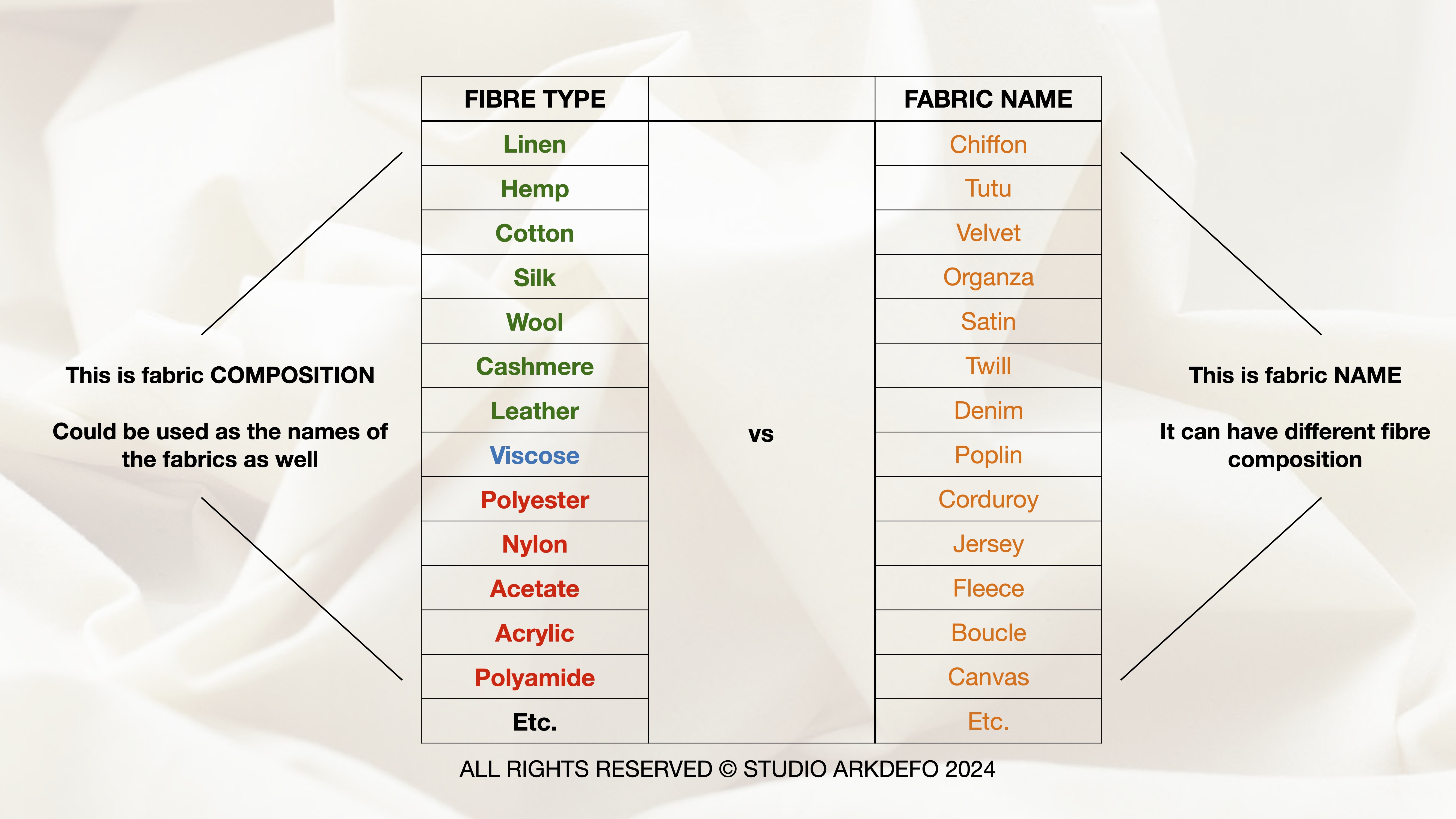
Composition (or the fabric ingredients) can be natural (cotton, linen, hemp, wool, etc.), synthetic (polyester, acrylic, nylon, etc.), man made (viscose, rayon, etc.)) and mixed blend (poly-cotton, cotton-linen, polyester-nylon-elastane, etc.).
When you shop, you need to look for composition. Very often they hide it under fabric types.
Lace, chiffon, faux leather, faux fur, denim, twill, tartan, check, striped, velvet, jersey, knit, woven, satin, taffeta, guipure, crepe-de-chine, tutu etc are fabric types.
They can be of any composition.
You need to look for the ingredients.
Some brands say things like “textile lining” - what does it mean? What textile?
Quick shortcut for you: if something is natural, organic, 100%, pure - they will shout so loud about it, it will be all over the product description. Organic cotton & recycled cotton lining - oh yeah, they are very proud to be using natural fibres and they are happy to showcase to.
Whereas textile lining - most likely will be some synthetic mix. They love to charge you a lot but they won’t disclose the use of cheap polyester lining.
Learn to read past the marketing bs.
If you want to learn more about fabrics, we’ve included a very comprehensive fabric webinar with every gold and platinum package of our clothes-making courses.
One more thing!
We now stock the most luxurious 100% natural jerseys in our fabric shop. We took a trip to Portugal in June and hand picked the most beautiful deadstock knits from a factory in the North. Zero synthetics, only pure cottons & linens and cotton-linen blends :)
HAVE YOU SIGNED UP TO OUR COURSES YET?
Build your clothes making skills step by step with our comprehensive learning system
NOVICE
No experience
DON'T KNOW HOW USE A SEWING MACHINE
Start with our Free Sewing Course
• Learn how to use & troubleshoot a sewing machine
• Learn how to sew straight
• Conquer the fear of sewing machines
• Learn how to make simple patterns
• Learn to design & sew simple projects: from scrunchies to bags
BEGINNER
Some experience
KNOW HOW TO USE A SEWING MACHINE
Start with our Clothes Making Course for Beginners
• Learn how to work with your measurements
• Learn how to draft simple boxy patterns
• Learn to design & sew simple relaxed fit garments
• Learn to design & sew short sleeve tops & shirts
• Learn to make cozy jumpers & hoodies
• Learn to design & sew boxy shirts
• Learn to design & sew lined jackets
ADVANCED
Plenty of experience
GOOD AT SEWING, MADE CLOTHES BEFORE
You are ready to jump straight into our Advanced Clothes Making Courses
• Learn how to work with your measurements
• Learn how to make a custom bodice block (sloper)
• Learn to design & sew all types everyday tops
• Learn how to design different necklines & collars
• Learn how to design different sleeves
• Learn how to make a custom skirt block
• Learn how to design dozens of different skirts
• Learn how to make a dress pattern
• Learn how to design & make a perfect dress
FULL ROADMAP TO CLOTHESMAKING
GET ALL COURSES WITH -50% OFF!
Get our best saving deal and learn new skills step by step. The bundle of everything includes every single course we have and is yours for life. From basic sewing skills and making simple boxy tops, to advanced pattern drafting & designing your perfectly tailored wardrobe.